
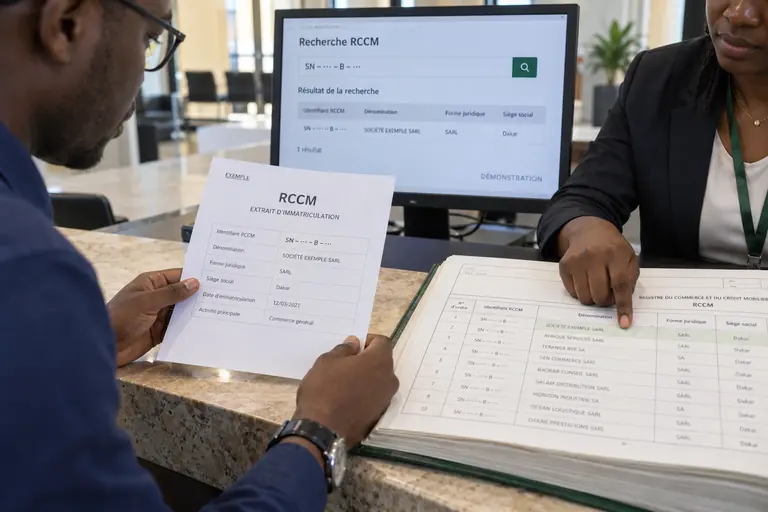
For anyone filing in Ivory Coast, commercial register RCCM registration documents are the papers that prove identity, legal form, seat and activity when a business asks to be entered in the official register of traders and companies. The register belongs to the OHADA system and is kept by the registry of the competent court. A sole trader's file centres on the person, a limited company's file centres on articles of association and managers, and a foreign firm's branch file draws on documents from the parent company. Lists and charges are set by the authorities and can be changed.
Why entry in the register is compulsory
The register of commerce and personal property security is the official record of traders and companies in the OHADA states. Entry is what allows a business to operate regularly: it produces an identification number, makes the business enforceable against third parties and allows it to open accounts, sign contracts and answer public tenders. The number then follows the business in dealings with banks and tax authorities.
For a company, entry marks the acquisition of legal personality. Before that moment the founders act in their own names and carry personal liability for what they commit. This is why advisers recommend avoiding any major undertaking until the registration number has been obtained and the company can contract in its own right. Practical consequences of that gap can be severe if the venture fails before registration is complete.
The obligation does not apply only to large structures. A sole trader, a craftsperson who also sells goods and a small company must all register. The nature of the activity and the legal form then guide the content of the file, which is why each deserves its own preparation. A very small business may therefore need almost the same discipline in preparing its file as a larger one.
Where the file is deposited
The file is lodged with the registry of the competent court, for example the commercial court of Abidjan for entities that have their seat there. Simplification websites describe steps such as buying an application form, depositing the file and receiving the registration number, and the founder should compare that description with what the registry says on the day. Comparing the two descriptions often reveals small differences worth clarifying in advance.
The investment promotion centre offers its own one-stop desk for business formalities. This service puts several creation steps in one place, which reduces the number of trips. An entrepreneur can ask the desk which circuit fits a given type of business, and whether the registry still needs a separate visit. Such a conversation is also the moment to find out about opening hours, payment methods and the form in which receipts are given, since these details differ between offices.
Practical details, exact papers and tariffs are fixed by the authorities and can change. Before preparing the file, they should be checked with the competent body, so that no unnecessary document is produced and no required one is missing when the file is handed over. A founder who keeps a dated note of each answer will be able to show later what was said, and by whom, if the counter changes its approach between two visits or two employees.
Papers of a sole trader
For an individual enterprise, the file revolves around the identity of the trader. It generally contains a valid identity document, proof of the place where the activity is carried on, a declaration stating the nature of the trade and, in some cases, papers concerning the person's criminal record. Photographs and a completed form are often added. Applicants should bring original documents, since copies alone may not be accepted for the identity check.
A foreigner wishing to trade individually may face further conditions, such as a residence or work authorisation. These depend on nationality and on the activity, and the precise list should be requested at the counter. No online summary can stand in for that local check, particularly when the rules were changed recently. Such conditions are particularly relevant where the trade requires regular travel or the employment of other staff members.
The sole trader answers for commitments with personal assets, which distinguishes this form from a company. The file reflects this reality because it concerns a person more than a structure. That is one reason the choice of form should be considered carefully before any paper is signed. For someone who prefers to limit risk, a company may be easier to manage, although it brings heavier paperwork and ongoing duties that a person trading alone does not carry.
Papers of a limited or public company
Companies set up as limited liability companies or public limited companies file a thicker dossier. It usually has signed articles of association, a statement on the subscription of capital and the release of contributions, the list of managers and papers proving their identity and good standing. The articles reproduce the mentions that OHADA law demands. Statements about capital must match the figures written in the articles exactly, down to the way amounts are expressed.
Further papers deal with the registered seat, such as a lease or a domiciliation certificate. Where contributions are made in kind, they are described and valued. A public limited company has more organs, such as a board of directors, which means additional appointment documents are needed in the file. A lease should be signed by the right party and cover commercial use, otherwise the registry may query it.
Many founders prefer articles drafted by a legal professional, because that reduces the risk of errors. Depending on the form and the size of the contributions, a notary may have to be involved. Whether this applies should be confirmed for each project, since it varies with the nature of the company. The chosen professional should be told at the outset which documents the registry expects, so that the articles can be drafted accordingly and the draft reviewed by every partner before signing.
Branches and foreign companies
A foreign company that opens an establishment in Ivory Coast also needs a register entry. Its file contains documents from the parent firm, such as proof of its existence in its home country, its articles of association and the decision to open the branch. Published procedures for creating a branch directly list several stages with different administrations. Business visitors who only want to trade temporarily should ask whether another arrangement is more appropriate.
Foreign documents often have to be legalised or apostilled and translated into French. This takes time, so it is better to begin early. A recent extract from the register of the home country, issued only a few weeks before, is frequently requested to show that the parent company is in good standing. Translations should carry the translator's seal on every page, and each document should keep its link with the original, so the registry can compare them if it needs to.
The branch's representative must be appointed with defined powers, and presents his or her own identity papers and, if applicable, residence evidence. The register then shows the link with the foreign company, which remains responsible for the commitments its branch takes on. The foreign parent remains answerable for the branch, a point lenders and customers will want to confirm in the register.
Checking the file before it goes in
An error-free registration begins with the list of papers obtained from the desk, followed by a check of every item. Names must be spelled identically on all documents, because a small difference can halt a file. Dates should be recent and signatures complete, and the signatory's capacity should be clear on each paper. Reading the file aloud against the checklist is a simple way to find omissions before the registry does.
Costs deserve attention as well. Depending on the case they include the price of the form, registration duties and the fees of a professional. No amounts appear here, as they change, and only the official schedule is authoritative. A written quote from any provider helps avoid surprises. Asking for a quotation that lists each cost separately is a cheap and effective safeguard.
Finally, getting the register number does not close every formality. Tax and social registrations usually accompany creation, and the one-stop desk can say which apply to the project. Once the business is registered, extracts, amending entries and eventually cancellation continue the cycle. These remarks are general information and not legal advice; an Ivorian lawyer or notary can confirm the procedure that fits each case.
Frequently asked questions
Do all businesses present the same papers?
No. A sole trader shows identity, proof of the place of activity and a declaration of the trade. A company adds articles of association, capital statements and details of its managers. A branch of a foreign firm adds documents from the parent. The registry or the one-stop desk gives the current list.
Do foreign documents need translation?
Often yes. Documents issued abroad are commonly legalised or apostilled and translated into French by a sworn translator. Because this step can be slow, begin it as soon as the structure is decided, and ask the registry which formalities it accepts for the particular document and country.
Is a notary compulsory?
Not in every case. Some company forms or contributions call for a notary, while simpler structures may not. The requirement depends on the legal form, the nature of the contributions and the rules in force, so it should be confirmed with the registry or a professional before the articles are signed.