
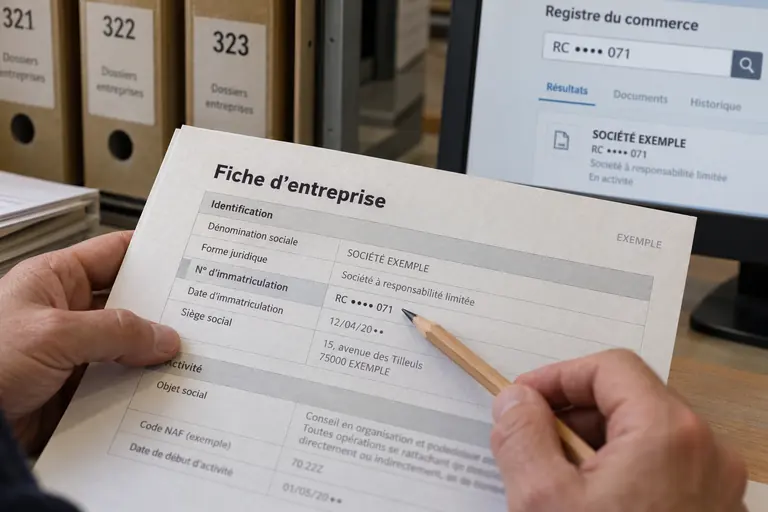
In Cáceres, the commercial register company records begin on the day a new business is registered and continue throughout its life. A registrar reviews the incorporation deed, checks that it complies with national company law and then enters the firm's name, form, registered address, purpose and administrators. Later events such as capital changes, new managers or dissolution are added in sequence. The result is a public, dated history of the legal entity, which grants the company full corporate personality and lets outsiders rely on what is written.
Before any paperwork: choosing the structure
Anyone planning a business in the province of Cáceres, whether in the capital, in the northern valleys or in towns such as Plasencia, Coria or Navalmoral de la Mata, must first decide on a legal form. The limited company is the common choice for small and medium ventures because shareholders risk only what they contribute, while the public limited company suits larger projects or those meant to attract outside investors.
Not every activity requires registration. Self-employed professionals can work as individuals without entering the commercial register unless the law demands it in their particular case, and some groups of entrepreneurs operate through other structures. Understanding this early prevents a founder from spending time and money on a registration that adds nothing to the project. The cost of an unnecessary registration is small but entirely avoidable.
Social economy entities form a separate world. Cooperatives and labour-owned companies in Extremadura follow their own registration channels, so a founder who wants a cooperative should not expect the commercial register to handle it. Choosing the structure first, with a lawyer or adviser if needed, determines which office will eventually receive the documents. The wrong choice at this point is costly to reverse once a deed is signed.
Founders who plan to bring in foreign partners should also think about language and paperwork. Documents signed abroad usually need to be legalised or certified so that a Spanish notary and the registrar will accept them, and translations may be required. Allowing time for these formalities avoids a stalled incorporation while everyone waits for a missing paper. A clear checklist drawn up with the notary helps considerably.
Name, deed and tax number: the preparatory steps
The first formal step is to obtain a certificate confirming that the chosen company name is not already taken. Name certificates are issued through the central name index and are valid for a limited period, so the next stages should follow without long delays. Choosing an original name saves trouble, because close similarities with existing names can lead to refusal. A distinctive name is also easier to defend commercially.
Next, the founders attend a notary to sign the deed of incorporation, which includes the articles of association. These set out the name, registered seat, corporate purpose, administration system and rules for transferring shares. The notary verifies identities and the contribution of capital, and the deed becomes a public document that forms the basis of the later registration. Errors in the deed are expensive to fix afterwards.
A provisional tax identification number is requested before the deed is signed, because the company needs it to open accounts and carry out transactions. Once the registration is complete, the definitive number is assigned. Founders who are foreign nationals may need an identification number of their own first, which can add steps and should be planned for in advance. Banks may also ask for additional identity documents.
Presenting the deed and the registrar's review
After the deed is signed, it is presented to the commercial register of the province where the company will have its seat. Presentation is nowadays normally made electronically, often by the notary or by a representative of the founders. The submission starts a review period in which the registrar examines the document before any entry is made. Delays at this stage are usually caused by incomplete files.
This review is called qualification. The registrar checks that the deed meets legal requirements, that the name is available, that mandatory clauses are present and that nothing contradicts earlier entries. If something is wrong, a defect is notified and the founders must correct it. Properly drafted articles pass without comment, whereas improvised wording often triggers delays. A short check by the notary before presentation is cheap protection.
Once the deed is accepted, the entry is made and the company acquires full legal personality as a registered entity. The registrar's work ends with the entry, but the public record is only beginning. From that moment anyone with a legitimate interest can request information about the firm, and the founders should be aware that the main details become visible to third parties.
In practice, the speed of the whole process depends heavily on the quality of the file submitted. Complete documents, consistent names and clear articles shorten the path, while missing powers of attorney or unclear descriptions of the corporate purpose provoke questions. Many founders engage a gestor or a law firm to handle presentation, which is reasonable, provided they keep copies of everything submitted.
Reading the company file after registration
The opening entries of a file in the Cáceres register give the company's name, legal form, registered address and date of incorporation, along with its purpose and the identity of the administrators. They also set out the way the company is represented, which determines how many signatures are needed for different decisions. These facts remain visible until they are changed by a later entry.
Subsequent entries chart the life of the company. A relocation within the province, an increase of capital to finance new machinery, the appointment of a new administrator or the transformation into another legal type all appear in order. A banker reading the sheet can quickly see how often the business has changed its structure and whether the changes follow a coherent pattern.
Extraordinary events are recorded too, including dissolution, liquidation and bankruptcy proceedings. A company in liquidation continues to exist, but its purpose is to settle debts and distribute what remains. Partners considering a deal with such a firm need to understand that its capacity to take on new commitments is sharply limited, whatever its previous reputation may have been. Prudence is the only sensible policy here.
Recent incorporations deserve a note of caution of their own. A company registered only a few months ago has no accounts history and no track record, which does not make it suspect but does mean that a prospective partner must rely more on the shareholders and administrators behind it. Those names are the real guarantee. Seeing who they are in the file is therefore particularly valuable. It also shows whether the same people appear in other companies.
Obligations that keep a company in good standing
Capital companies must deposit annual accounts after approval by their shareholders. Failing to do so can lead the registrar to close the company's sheet, which blocks most new entries until the omission is remedied. This consequence surprises many founders, who treat the deposit as a formality and only learn of the penalty when they need to register a change. A routine renewal of the accounts calendar prevents this.
Other duties exist as well. Companies must update the register when administrators change, when the registered address moves or when capital is modified. They must also keep their corporate books in order. Leaving these tasks to the last moment is a common cause of friction with banks and notaries, who insist on up-to-date registry information. A calendar of recurring duties is a simple remedy.
Ownership transparency is another consideration. Rules on beneficial ownership require companies to identify the real people who ultimately control them, and this information is held in separate registers with their own access conditions. It does not appear in an ordinary commercial extract, so lenders wanting this information must follow the specific channel. The two sources complement one another rather than overlap.
Failing to comply with these formalities can lead to sanctions and to practical obstacles with banks, which increasingly ask for evidence that the beneficial ownership data are up to date. Founders are well advised to keep a simple internal file showing who the controlling persons are, how control is exercised and when the information was last reviewed. Auditors appreciate such records.
Retrieving information about an existing business
For an outsider, the easiest way to see what is recorded about a business is the simple extract, which gives a summary of current data. It is requested with the company name or tax number and delivered in electronic form. For ordinary commercial decisions, such as agreeing credit terms with a supplier in Extremadura, it is usually sufficient and quick to obtain.
When a bank, public authority or court needs proof, the registrar's certificate is the right tool. It certifies the contents of the register and is accepted as formal evidence. There are variants, so applicants should state precisely what they need to demonstrate. Charges and timings differ among services, and the official channels of the registrars give the current conditions. Prices should never be assumed from older invoices.
Requesters are expected to identify themselves and give a legitimate purpose. Names of administrators are published because of their function, and may be used for ordinary business reasons but not for mass marketing or profiling. Anyone who is unsure about permitted uses should consult a lawyer before building databases from registry information. Compliance with data protection law applies to every user.
Frequently asked questions
Do all businesses in Cáceres have to register in the commercial register?
No. Capital companies must register, and some other businesses must as well, but self-employed individuals generally operate without a commercial registration unless the law requires it in their case. Cooperatives follow their own registration route. Check your legal form with an adviser before starting the process.
What happens if the registrar finds a defect in my deed?
The registrar notifies the defect and the founders are given the chance to correct it. Typical problems include unavailable names, missing mandatory clauses or inconsistencies with earlier entries. Once the deed is amended and presented again, the review continues. Careful drafting by a notary or lawyer reduces the risk of such delays.
Can anyone view the company file of a Cáceres business?
Registered data is public, but access is organised through documents such as extracts and certificates, and applicants are expected to identify themselves and state a legitimate purpose. Information on ultimate beneficial owners is held separately and follows its own access rules, so it is not part of an ordinary company extract.