
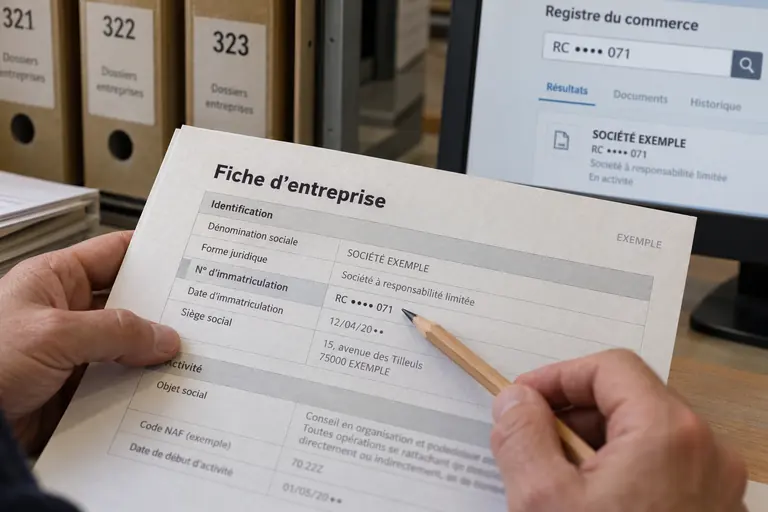
Spain's official company register certification is the document through which a registrar attests, under personal responsibility, what the Mercantile Registry contains about a business. Unlike an informative note, it is signed and carries full evidentiary value before courts, notaries, banks and public bodies. It may reproduce the entries literally or confirm specific facts, such as the powers of an administrator or the existence of a company at a given date, and it is the instrument of choice whenever a third party demands formal proof.
The registrar's signature makes the difference
In Spain, the person in charge of each Mercantile Registry is the registrar, a legal professional who examines filings and is responsible for the accuracy of what is entered. When the registrar issues a certification, the document represents a legal attestation of the content of the register. That personal responsibility is why it is accepted as evidence in situations where simpler documents are not. The certification is normally issued electronically with a qualified signature, or on paper with a signature and the registry's seal.
It refers to the date of the information, and it includes identifiers that allow the recipient to verify it. A document without those elements should be treated with caution, whatever its title suggests. Because the certificate carries legal weight, its issue follows more formal steps than a note. The requester must identify the company precisely and state what is to be certified. The registrar may decline to certify matters that are not recorded, and the certificate will only reflect what the register actually contains.
Because the registrar answers personally for the certificate, the registry will sometimes ask questions before issuing it. An unclear request, a company that cannot be identified with certainty, or a demand to certify something the register does not contain can all lead to a delay or a refusal. Answer promptly and in writing so that the file moves forward. This habit is especially useful when several people handle the same file over time.
Certification compared with the nota simple
Both documents draw on the same register, and both can be requested by interested persons, but they serve different purposes. The nota simple informs, quickly and cheaply, whereas the certification proves. If a bank asks for proof that an administrator holds certain powers, a note will rarely satisfy it, because the note carries no formal guarantee from the registrar. The practical consequence is a two-step approach followed by many professionals.
Start with the note to verify the data and decide whether the company is the right entity. Then order the certification for the exact facts required by the recipient. This saves money when the first check reveals a problem, and avoids needless formal documents for businesses that are not pursued. Check which document the receiving party accepts. Public tenders, foreign branch registrations, court proceedings and some financial operations explicitly ask for a certification.
When the request says only registry information, clarify whether a note is acceptable, since rejected documents cause delays that exceed the small price difference. Some recipients are not familiar with the registry's vocabulary and simply ask for an up-to-date certificate of the company. In that case, a certification of current entries is usually the safest choice, because it covers the registered data a counterparty normally wants: name, address, purpose, capital and the persons who can bind the company.
Kinds of certification commonly requested
A literal certification reproduces the content of the entries, in whole or in part, as they appear in the register. It is useful when the recipient wants to see the exact wording of a registered clause, such as the limits placed on administrators or the description of the corporate purpose. The text of the entry is transcribed rather than summarised. A certification by content or in relation certifies particular facts drawn from the register, for example that the company exists, that a named person is its administrator, or that no entry of a certain kind appears.
It is more concise than a literal copy and often suits requests where the recipient needs a clear statement rather than the full text. Certifications can also concern the name of a company, the deposit of accounts or the absence of registration. Each has its own purpose and conditions. When filling in the request, describe the specific fact to be proved, and the registry will suggest the form that fits. Vague requests are the main cause of documents that do not meet the recipient's needs.
Powers of administrators deserve special mention. Many requests concern the certification of the appointment and the faculties of a person who will sign on behalf of the company. Because the registered limits on those faculties can differ from what a manager claims, a certificate on that point protects the counterparty from signing with someone who lacks the necessary authority. It also gives colleagues a clear record of what was verified and when.
Ordering a certification step by step
First, identify the registry competent for the company, which is the one at its registered office, and gather the name and tax number. Second, decide the type of certification and the period or date to which it should refer. Third, submit the request through the registry counter, the profession's online platform or an authorised agent, and pay the applicable fee. The registry then prepares and signs the document. Delivery can be electronic, with a verifiable signature, or on paper by post or collection.
For use in Spain, an electronic document is usually accepted. If your recipient demands the original on paper, say so when ordering, to avoid a second request after the digital version has been refused. Keep an eye on timing. A certification has a limited practical shelf life, as many recipients accept only recently issued documents. Plan the order so that it arrives shortly before submission, and allow extra time if the registry needs to review the file or if translation and authentication are required for use abroad.
Use abroad and other effects
Foreign authorities often ask for a registry certification when a Spanish company opens a branch, signs a major contract or takes part in a tender. In addition to the document itself, they may require a translation and authentication. Spain is party to the convention that replaces legalisation with an apostille for countries that also apply it. Where an apostille is needed, request it from the competent authority after obtaining the certification, and check whether it must be attached to the original or to a notarial copy.
For countries outside the convention, the longer route through the foreign ministry and the consulate may apply. Ask the foreign recipient for written instructions. Within Spain, the certification is used in notarial deeds, bank procedures, court cases and administrative filings. A notary may rely on it to confirm the powers of a person signing for a company, and a court may accept it as proof of corporate data. In each case, its effect is limited to what the register shows.
If the document will be used in a country with its own rules on corporate evidence, speak to a local adviser before you order. A foreign lawyer can tell you the form of certification that will be accepted, how recent it must be and whether a notarised translation is required, which saves repeated orders and keeps the transaction on schedule.
Precautions and limits of what it proves
A certification proves what is recorded, not what is true in the wider sense. It confirms that an entry exists, that a person is registered as administrator and that certain data was filed. It does not guarantee solvency or compliance with other legal duties, and it cannot reveal obligations that were never registered. Its date also limits it. If something happens after issue, such as a resignation filed the next day, the certification will not show it.
For high-value operations, order a fresh document close to the moment of use, and ask the counterparty to confirm that nothing has changed since the date shown. Finally, check every detail upon receipt: the name, the tax number, the date, the signature and the content requested. Errors, though rare, should be raised with the registry at once. A certification that fails to meet the recipient's requirements loses its purpose, so verify it against the instructions you were given before sending it on.
Frequently asked questions
What is the difference between a certification and a nota simple?
The nota simple is an informative summary of registry data, quick and inexpensive but without formal value. The certification is issued and signed under the registrar's responsibility and is accepted as official evidence by courts, notaries, banks and public bodies, which is why formal procedures usually require it.
Can I use a Spanish registry certification abroad?
Generally yes, usually with a translation and an apostille or legalisation, depending on the destination country. Ask the foreign recipient exactly what it needs, request the authentication after obtaining the certification, and allow extra time for each of these steps.
Does a certification prove that a company is financially sound?
No. It proves only what the Mercantile Registry records, such as the company's existence, its administrators and certain filings. It says nothing about solvency or unregistered obligations, so combine it with deposited accounts and other checks before an important transaction.