
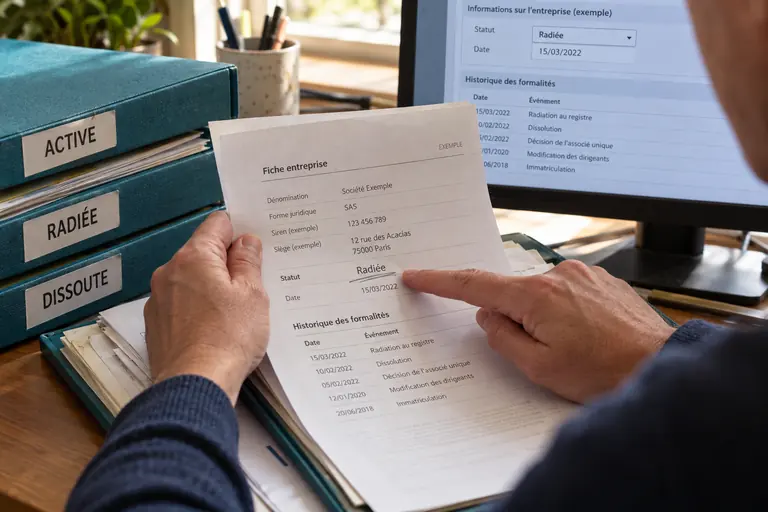
Guinea-Bissau's official company register records the legal existence of businesses trading in the country, from sole traders to limited companies. It belongs to the commercial register system shared by the member states of OHADA, the African business-law organisation, so entries follow common rules about identification, registration numbers and modifications. A file normally shows the trade name, the legal form, the registered address, the people who manage the business and any later changes. Because it is a public instrument, it gives lenders, suppliers and buyers a first reliable picture of who stands behind a company.
A register built on regional business law
Guinea-Bissau is a member of OHADA, the Organisation for the Harmonisation of Business Law in Africa, and that membership explains a great deal about how its business records look. Instead of a purely national set of rules, the country applies uniform acts on general commercial law and on commercial companies. These texts define who must register, what a registration number means and how a company is born, changed and removed from the books.
The practical result is that a file from Bissau resembles files from Dakar, Abidjan or Douala more than one might expect. The same vocabulary appears: commercial and personal property credit register, additional declarations, modifying entries and deregistration. A professional used to one OHADA country will therefore read a Bissau extract without much trouble, although the language of the document is Portuguese in the local context.
Domestic legislation still matters around the edges. National decrees decide which office receives the filing, which notarial or administrative steps come first, and how fees are collected. Readers should treat the regional acts as the backbone and the national measures as the details that must be confirmed with the competent office before any filing or request is prepared. Reading both layers together avoids surprises.
A further consequence of the regional framework is stability of concepts. Terms such as legal personality, registration number and deregistration carry predictable meanings, so a foreign investor can anticipate how a Bissau entity will be treated in a contract, a financing file or a cross-border dispute, even if the local procedure takes some patience. That predictability is a quiet advantage for anyone comparing several African markets before choosing where to invest.
Who keeps the books and where they sit
In OHADA systems the commercial register is normally held at the level of the court that has jurisdiction over commercial matters, with a clerk responsible for receiving declarations, assigning numbers and keeping the file in order. In Guinea-Bissau the capital is the natural centre of that activity, since most active businesses, banks and public bodies are concentrated there. Whoever holds the pen at that counter also decides which documents are complete.
Because organisation can change, it is wise to confirm which counter currently handles company files, whether a single window for business formalities operates alongside it, and which ministry supervises the process. Announcements about simplification of formalities have been common across West Africa, and the arrangement that applied to one entrepreneur may not apply to the next. A quick enquiry before travelling can save a wasted journey.
Do not expect the register to behave like a searchable website in every case. Many users obtain information by visiting the office, sending an authorised representative or asking a local lawyer or notary to request an extract. Plan for this by preparing the exact name of the business and, if you have it, the registration number given on its invoices or contracts.
What an entry usually contains
A typical entry opens with the identity of the business: its legal name, any commercial name or sign, the legal form and the main activity. For a company it adds the registered office and the persons authorised to represent it, such as a manager or director. For a sole trader the file centres on the individual, who answers personally for the debts of the activity.
Later events are recorded as modifying entries. A change of address, a transfer of management, a capital movement or a change of purpose should leave a trace, and the order of these entries shows how the business evolved. A reader comparing a contract with the file can quickly spot whether the person who signed really had authority on the date of signature.
The file proves existence and certain declared facts, but it does not audit them. A declared activity is not a licence, and a stated registered office is not proof that anyone works there. Treat the entry as a starting point and complete it with tax identification, sector approvals and, where relevant, evidence of premises and insurance. Think of it as the identity card of the business, not a certificate of quality.
Searching for a business with little information
Start with the spelling of the name exactly as it appears on a contract or invoice. In a Portuguese-speaking environment, accents, abbreviations such as Lda or SA, and variations between a trade name and a corporate name can all change the result. Write down every version you have seen and try each when asking the office or a local intermediary. Even small differences in spelling can send a clerk to the wrong folder.
If no registration number is available, add contextual details: the town, the activity, the name of the manager and the approximate period of creation. These details help the clerk separate two businesses with similar names. They also protect you from the common mistake of confusing a long-established company with a recent one that has borrowed a familiar name. Patience at this stage pays off later.
When you receive an extract, check its internal consistency before relying on it. Does the legal form match the name, does the address match the one given in the contract, and does the person named as manager match the signature? Any mismatch is a reason to ask a question, not necessarily proof of wrongdoing, but it should be resolved before money moves.
Finally, remember that the register describes the legal entity and not the whole group behind it. A subsidiary may be properly recorded while its parent sits abroad, and the Bissau file will not reveal what the parent owes elsewhere. Request group information separately when the size of the deal justifies it. That extra layer of research is routine for lenders.
Using extracts with banks, buyers and partners
Banks, importers and development partners often ask for an extract from the commercial register when opening an account or approving a transaction. The document is meant to show that the business exists, is in order with registration and is represented by the people who claim to speak for it. The more recent the extract, the more weight it carries in these discussions.
If a document will cross a border, additional steps can apply. Translation into the language of the receiving country, a certification of the signature of the issuing official and sometimes a form of legalisation may be requested. These requirements depend on the destination, so ask the receiving institution for its exact list before ordering anything from Bissau. Starting these steps early prevents last-minute delays.
Keep a copy of every extract together with the date on which it was obtained and the person who requested it. Registers evolve, and a clean file today does not guarantee the same tomorrow. A simple record of what you saw and when you saw it can be valuable if a dispute with a counterparty arises later. Such a note also helps colleagues who take over the file.
Limits and prudent habits
Registration systems in many low-income markets work with limited digitisation, and the information may be incomplete or delayed. A business can be operating before its latest modification is entered, or can remain on the books after it has ceased activity. For that reason, the register should be one source among several, never the only one. Treat every entry as a snapshot that needs confirmation.
Cross-check with the tax administration, the chamber of commerce and, for regulated activities, the relevant sector authority. Where possible, visit the premises or speak to existing customers. A short reference check often reveals more about reliability than an extract can, and it costs far less than recovering a payment from an unreliable partner. Triangulating sources is the cheapest form of due diligence.
This text gives general orientation only and is not legal advice. Fees, delays and documents change, and the competent office remains the authority on what is currently required. When a transaction is large or the counterpart is unknown, ask a lawyer in Bissau to verify the file and confirm that the registration is current. Professional review is a modest expense compared with the risks of an unchecked deal.
Frequently asked questions
Is the company register in Guinea-Bissau open to the public?
In principle the commercial register exists to give publicity to business facts, so interested parties can ask for extracts or consult entries. The practical method varies: you may need to apply in person or through a representative. Personal data may be limited, so confirm with the competent office what can be released to you.
What identifies a company in the register?
A company is identified by its legal name, legal form and a registration number issued when the file is opened. Tax identification is handled separately by the tax administration. When checking a business, compare the name and number on contracts with the extract, since both should match.
Can a registered company still be unreliable?
Yes. Registration shows that a business exists legally and declared certain facts, but it does not guarantee solvency, quality of service or compliance with every sector rule. Combine the extract with bank references, tax status checks and, for important deals, an independent legal review.