
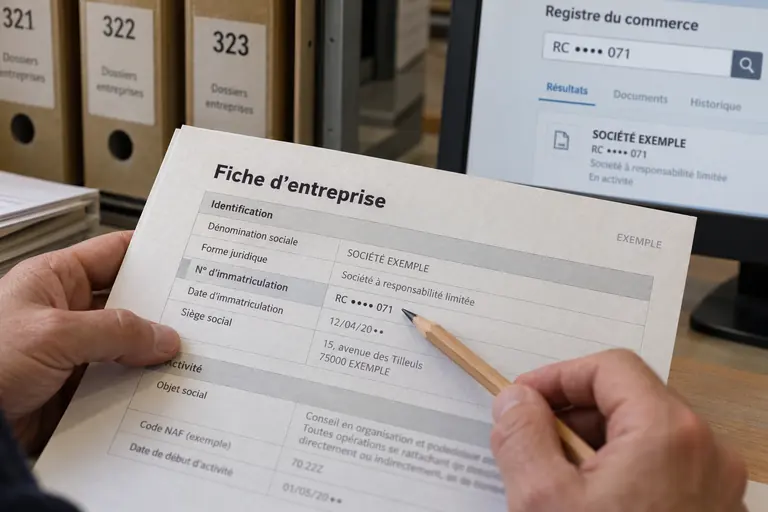
Mongolia's company register and business records are kept by the General Authority for State Registration, a central body that registers legal entities, property rights and other civil facts. Every entity is entered under a state registration number and a register number, and the file shows its name, form, address, capital, objects and managers. Ulaanbaatar hosts the head office, but local branches serve provinces. The language of the documents is Mongolian, written in Cyrillic, so translations are generally required for foreign readers.
The General Authority for State Registration
Mongolia concentrates much of its civil and commercial registration in a single institution, the General Authority for State Registration. It records legal entities, but also marriages, births, real estate and movable property rights, which is why it is a familiar body for citizens as well as for businesses. Legal entities are registered under the law on the state registration of legal entities, alongside the Company Law and other sector rules. When a company is formed, its founders submit the articles, the identification of the founders and the proof of address, and the authority checks that the name is available. The headquarters is in the capital, while provincial and district offices handle applications locally.
A business in a distant aimag can therefore register without travelling to Ulaanbaatar, although the file belongs to the same national registry system. Registration has been moving online, and electronic services allow applicants to submit documents and obtain certificates. Outsiders should verify what is currently available and what the public can see, since services and rules are updated from time to time. The authority also records changes over time, such as new managers, address updates and increases in capital. A current extract therefore reflects the latest registered situation, while earlier versions of the charter can be requested when someone needs to understand the history of a company or a disputed decision.
Company forms recognised by Mongolian law
The Company Law provides for limited liability companies, which are the most common vehicle, and for joint-stock companies, divided into those that offer shares publicly and those held privately. Partnerships and other forms also exist, though they are less frequently met in practice. Sole proprietors can register as individual businesses. Unlike a company, they are not a separate legal person, so liability rests personally with the owner. This difference should shape the contract and the due-diligence approach when dealing with small operators. Foreign investors may form wholly owned or jointly owned companies, subject to sector rules.
Mining, strategic resources and certain media or financial activities carry special conditions, and approvals from sector bodies sit outside the standard registry entry. State-owned enterprises are numerous in sectors such as energy, rail and mining. Their records show government participation, and decisions can involve ministries and parliament. Reading the shareholder and board information reveals how closely a firm is tied to public authority. Companies must hold a general meeting of shareholders and keep minutes, and the charter sets out who may act for the company. These internal documents are not published in the registry, yet they can be requested from the company, and a serious partner will usually supply them.
Register numbers, tax numbers and permits
Each entity receives a registration number that appears on the certificate and is used across administrations. A separate register number, usually a multi-digit code, is common in business correspondence. Together with the legal name, these numbers help to identify the entity precisely. Tax registration is handled by the tax authority, which assigns taxpayer numbers and tracks filings. Invoices should carry the correct numbers, and a company that cannot provide tax registration details should raise concern, since a functioning business would normally hold them. Sector permits come from specialised bodies. Mining and exploration licences are held by the mineral resources authority, and other activities such as banking, insurance and communications fall under their own regulators.
The registry confirms existence, not permission to operate in these fields. Mongolian names are written in Cyrillic, and transliteration into Latin letters varies. A single company may appear under several spellings, so compare numbers and addresses and ask for an official English translation when a document must be shown outside the country. Land use rights, which are separate from ownership in many cases, are registered in the property records and not in the company file. If a deal involves a plant, ger district plot or a pasture right, request the relevant property certificate as well.
Looking up a company and obtaining extracts
A first search can be made with the legal name or the register number, using the electronic services of the registry authority where open to the public. The result normally confirms that the entity exists and gives core details such as status and form. For official use, an extract or certified copy is requested from the authority, either online or at a counter. The applicant may be asked to show identity and, where the entity is not the applicant's own, to explain the reason.
Fees and processing times depend on the service chosen. Foreign parties often work through a Mongolian law firm or accountant who can obtain documents and translate them. A power of attorney, signed according to local formalities, is usually enough to authorise these tasks without a trip to Ulaanbaatar. Documents intended for use abroad may need an apostille, since Mongolia participates in the convention. Verify the requirements of the receiving authority and make sure the translation follows the original and is certified if required.
Limits of transparency and where to look further
Registry data is helpful for establishing identity, representatives and basic corporate facts. It is less revealing about finances, contracts and the persons who stand behind shareholders. Efforts on transparency of ownership have progressed, especially in extractive industries, though not every detail is open. Listed companies and certain large entities publish reports through the stock exchange and regulatory channels. These reports give a closer view of operations and ownership, and they are more informative than the registry entry for a private firm. Licences for mining or land use, along with environmental approvals, are held by separate bodies and may be searched in their own databases.
When a business claims rights to a deposit or a plot, request the licence itself and check its validity period and boundaries. Court decisions, enforcement actions and tax arrears are not in the company registry. A request for confirmation from the counterparty, backed by a contractual warranty, offers some protection, and a local lawyer can often perform targeted checks quickly. Because the country relies heavily on resource exports, investors often ask for information on licence holders and beneficial owners. International initiatives have encouraged publication of such data, and local regulations on disclosure continue to develop, so check what is currently released.
Practical advice for foreign partners
Before committing, collect the certificate of state registration, the charter, the latest extract, the tax registration and any licences, then review them for consistency. A discrepancy in the legal name or number should be resolved in writing, preferably with a corrected document. Confirm who has authority to sign. The director named in the extract normally represents the company, yet the charter can require additional approvals for major transactions, and a board decision may be needed. Ask to see it when amounts are significant.
Account for distance and seasonality. Mongolia is a vast country, and travel to provinces can be slow in winter. Build time into schedules, and arrange for a representative to visit sites that are key to a transaction. Keep a dated file of documents and update it before payments and renewals. Businesses change managers, move offices and alter their charters, and your file should show that you verified the facts as they stood at each important moment.
Frequently asked questions
Which body keeps Mongolia's company records?
The General Authority for State Registration, with its head office in Ulaanbaatar and offices in provinces and districts. It registers legal entities and also records civil status and property rights. Applications can increasingly be made online, though the services open to the public may change.
Is a Mongolian registration enough to show a mining company can operate?
No. Registration proves that the entity exists, while mining and exploration need licences from the mineral resources authority. Ask for the licence, check its validity and boundaries with the issuing body, and treat the registry entry as only one part of the file.
Do I need Mongolian translations of registry documents?
Documents are issued in Mongolian, so translations are usually needed for use abroad, and an apostille may be required because Mongolia takes part in the convention. Ask the receiving institution what it requires and use a translator familiar with legal terms.