
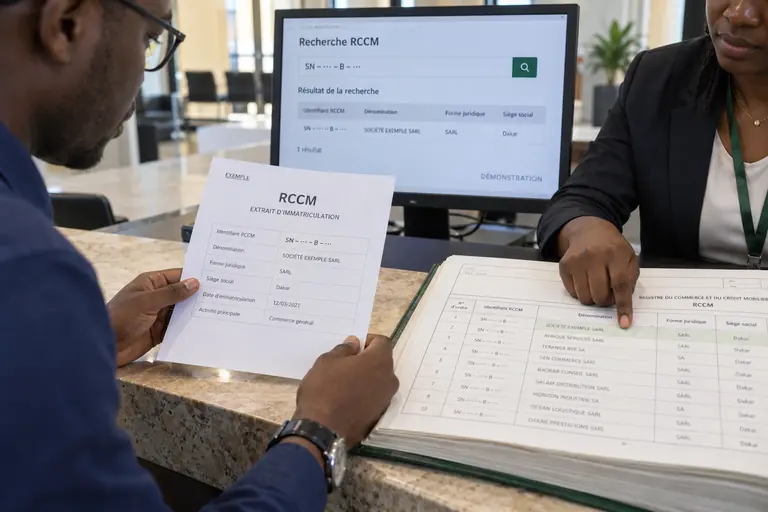
Senegal RCCM company register and business records show whether a trader or company is legally recorded, which is why serious contracts in Dakar start with a registration number. The register of commerce and personal property credit follows OHADA law, lists the name, form, address, activity and managers of each entry and publishes security interests over movable assets. Banks, exporters, ports and public purchasers rely on its extracts, which describe the situation of the business on the day they are issued.
Dakar as the hub of registration
Senegal has one of the most active business scenes in French-speaking West Africa, built around the port and airport of Dakar, services, fishing, agriculture, construction and a growing digital sector. The capital’s commercial court registry therefore handles a heavy flow of files, and many companies keep their registered office there even when they operate in other regions.
The country applies OHADA uniform acts, so the register follows the same structure as in Mali, Côte d’Ivoire or Togo. The definition of a trader, the effects of registration and the rules on publicity of security rights come from the common text, which gives banks and foreign partners a familiar legal frame.
Outside Dakar, towns such as Thiès, Saint-Louis, Kaolack and Ziguinchor serve their own areas through the relevant courts. A company is filed where its main establishment is found, so a business with a head office in Dakar and workshops in Thiès appears in the capital’s file and may mention the secondary site there.
Senegal’s tradition of stable institutions and its role as a regional financial and logistics platform make its register a frequent reference for businesses in the sub-region. Companies operating in Mauritania, Guinea, Mali and The Gambia often hold documents from Dakar. Reading them correctly saves time during due diligence and compliance reviews.
Understanding RCCM, NINEA and other identifiers
Senegalese businesses use more than one number. The commercial register number shows that a trader or company has been recorded. A separate national enterprise identification number, widely known by its acronym NINEA, is attributed by the statistics agency and used by the administration. Tax documents may carry yet another reference.
These numbers are not interchangeable. A contract may ask for the register number to confirm legal existence, while customs or tax forms request the identification number. When a business supplies only one of them, ask for the others, so that each administrative function can be matched with the right document.
Comparing names across documents is a useful routine. A trading name on an invoice might differ from the corporate name in the register, and the bank account may be held under yet another form. These variations are common and usually innocent, but a careful buyer clarifies them before payment is released.
A typical mistake is to treat the identification number as proof of commercial registration. It shows that the entity is known to the statistical system, not that it is a registered trader or company under OHADA rules. Keeping each number linked to the right document prevents embarrassing errors in contracts and customs files.
What the entry contains and how history is preserved
An entry identifies the business with its name, form and address, then describes its activity. Companies show their capital and the identity of the people who run them, together with the scope of their powers. This gives a counterparty confidence about who may bind the business and whether signatures from two managers are required.
Later events are recorded as amending entries. Increases of capital, changes of manager, transfers of the registered office and openings of branches leave a trace in the file. Reading the history, rather than only the current state, may reveal that a business has been restructured several times in a short period.
At the end of its life, a company goes through dissolution and liquidation before it is removed from the register. A removed entry means that the business no longer exists as a legal person, even if its older obligations may remain. Asking whether the entity is active, dormant or in liquidation is a basic step in due diligence.
Readers who study the history of an entry sometimes find a conversion from one legal form to another, for example from a sole trader to a limited liability company. Such a change is legitimate, and it usually signals growth. The new entry should still be consistent with earlier documents, including the same address or an explained move.
Creating a company with the investment agency’s desk
The agency in charge of promoting investment and major works operates a one-stop desk for business creation formalities. It brings together the administrations that take part in registration, tax recognition and social affiliation, so founders deposit a single dossier. The aim is to shorten delays and reduce the risk of incomplete files.
Applicants prepare articles of association drafted according to OHADA law, identity documents for the partners and proof of a registered office. A notary or lawyer can help with the drafting, especially for companies with several shareholders. The desk can confirm the up-to-date list of documents and any digital submission options.
Registration does not stand in for sector licences. Fishing, mining, banking, insurance, energy and transport require authorisations from the relevant ministries or regulators. A company may be properly registered and yet be unable to start work until these approvals are given, so partners should ask for them separately.
Business owners in the diaspora often create a company from abroad. This is possible through a representative and a power of attorney, with the one-stop desk and the registry providing the details. Preparing documents in the right form before travelling avoids a second trip and the costs that go with it.
Searching, ordering extracts and sending them abroad
To search effectively, start with the registration number or the exact company name and the town. Where several results appear, use the manager’s name and the activity to choose the right one. Take note of the legal form that follows the name, because two businesses with the same words may be different entities.
Registry staff deliver an extract that reflects the entries on the issue date. Many banks and public buyers require a recent extract, so it is wise to order one close to signature. Details such as online ordering and the price of copies are best checked with the registry or a local agent.
For use abroad, French documents may need translation, and legalisation may be required depending on the destination. Chambers of commerce and law firms in Dakar often assist foreign clients with these steps. Keep a record of the issuing office, date and number of the document in the contract file.
Cautions that go with any registry search
The register is not a rating agency. It does not say whether a company pays its debts, honours its orders or still trades. A business can be registered without any activity, and a thriving informal operator might not be registered at all. Both situations occur across the region.
Extra verification can include bank references, proof of premises, tax compliance documents and a conversation with existing customers. For exports and imports, check also that the company holds the customs and sector authorisations needed for the goods concerned. These checks are standard practice and do not imply distrust.
The notes here give general information and are not individual legal advice. Offices, procedures and online services evolve, and local practice can differ from the text. Before relying on a document for a major transaction, confirm the position with the registry or an experienced Senegalese lawyer or accountant.
Compliance teams in international banks increasingly look beyond the register and ask about the people who ultimately own or control the business. A company that can explain its structure clearly and provide documents promptly gains credibility. A company that hesitates may find that its application takes longer.
Frequently asked questions
What is the difference between RCCM and NINEA?
The RCCM number comes from the commercial register and shows legal registration of a trader or company. NINEA is a national enterprise identification number used by the administration for statistical and fiscal purposes. They answer different questions, so partners often request both.
Is the Dakar registry the only one?
No. Dakar handles many filings, but other courts serve businesses established in their areas, including towns such as Thiès or Saint-Louis. A company registers where its main establishment is located, and the clerk can confirm which jurisdiction applies.
Can I get an extract from outside Senegal?
Often through a representative. A lawyer, agent or chamber of commerce can submit the request and send you the document. Written authority may be needed, and you should ask the registry how requests are accepted and whether online options exist at present.