
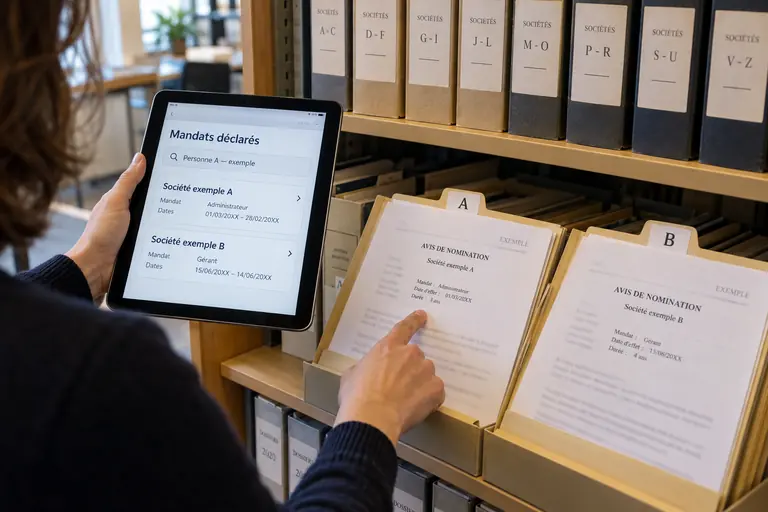
Colombia's commercial register RUES draws together the company records held by private chambers of commerce, to which the law entrusts public registry duties. Each chamber enrols merchants and companies in its own territory, notes their key legal acts and issues certificates on request. RUES, the unified business and social registry, links these local files so that one query can reach entities across the country. It shows identification data, the registration status and the legal representative, while formal proof comes from certificates.
Chambers of commerce, not courts, hold the files
Colombia handles company registration in an unusual way. Rather than a court or a ministry, the work is carried out by chambers of commerce, which are private non-profit bodies that receive delegated public functions. Each chamber covers a defined territory made up of a main city and surrounding municipalities, and it keeps the files of the merchants and companies established there.
A company is registered at the chamber closest to its main address, while branches and shops are recorded where they operate. That is why one business can appear in several chambers at once, each holding the part of the history that concerns its own territory. Anyone tracing a group of firms should expect to look in more than one local file.
Oversight does not sit with the chambers alone. A public supervisory authority for industry and commerce watches how they perform their registry tasks, and a national confederation of chambers coordinates shared systems. Those two layers explain why practices look broadly similar from Bogotá to smaller provincial cities even though every chamber runs its own registry. Because the system is decentralised, a chamber's own website often offers services that mirror the national window, such as certificate requests and status checks for enrolled firms. Those tools are convenient, yet the territorial logic stays the same: the chamber that enrolled the business is the one able to correct, update or certify the information held about it.
The matrícula mercantil and the number that follows a firm
The core entry in this system is the matrícula mercantil, the enrolment that identifies a person or company as a merchant. It gives the business a registration number within its chamber, and the same file collects later changes such as amendments to the bylaws, new appointments and the registration of commercial books. Colombian companies take several forms. The simplified joint-stock company has become the everyday choice because it can be formed by a private document, while the public limited company, the limited liability company and partnership types still appear in older records. The legal form is visible in the registry and tells a reader what rules govern the entity.
Tax identification works separately. The taxpayer number issued by the tax authority is widely quoted on invoices and contracts, and it is the most dependable search key because company names are often similar. Treat the chamber registration and the taxpayer number as two linked but different identifiers, and compare both before concluding that two names refer to one firm. Records of establishments follow their own logic. A shop, workshop or office operated by a company can be enrolled as a separate establishment with its own entry, so a search that returns the company but not a specific outlet may simply mean that the outlet is listed under a different name or was never enrolled.
What RUES adds to the picture
RUES is the unified business and social registry, administered by the confederation of chambers. It gathers data from the individual chamber systems and presents it through a single online window. Besides merchants and companies, it covers non-profit entities and the suppliers recorded in the bidders' registry, which makes it useful for anyone screening a potential counterparty. A search can usually start from a name or an identification number. The result lists the chamber that holds the file, the registration status and a few core facts.
Because RUES summarises rather than replaces the original files, the chamber remains the source of truth, and discrepancies should be resolved with the chamber itself. People often confuse RUES with the RUT, the tax registry kept by the tax and customs authority. They answer different questions. RUES tells you whether an entity exists legally and how it is enrolled, whereas the tax registry records fiscal obligations and responsibilities. Reading one cannot stand in for reading the other when a due-diligence file is being assembled.
Certificates that carry legal weight
The document banks, notaries, public entities and counterparties ask for most often is the certificate of existence and legal representation. A chamber issues it for companies enrolled with it, and it confirms that the entity exists, who represents it and within what powers. A separate certificate of registration covers the merchant's enrolment and its establishments. Which document to request depends on what must be proven. A buyer verifying who may sign a contract needs the representation certificate, whereas a tender may call for the supplier registration certificate. Copies of registered acts, such as bylaws or shareholder minutes, can also be requested when the underlying text matters more than the summary.
Certificates describe the situation on the day of issue, so an old printout proves little. Many chambers offer electronic versions with a means of checking authenticity, and receivers of a document should use that check rather than trusting a PDF at face value. Tariffs are set officially and change, so the current amount should be confirmed with the chamber before ordering. Recipients abroad sometimes ask for a legalised copy of the certificate. In that case the chamber's electronic document may need to be printed, translated and apostilled in line with the destination country's expectations, and checking this before ordering avoids paying for a document that the receiving office would refuse to accept.
Reading status, renewals and warning signs
The annual renewal of the matrícula is a feature unique to this style of registry, and it affects how a company looks when someone searches. A firm that has not renewed may show up as inactive or with an outdated status, even if it still trades in practice. Such a result is a prompt to ask questions, not proof of a problem.
Pay attention to the entity's address and its legal representative. A mismatch between the person who signed a contract and the representative on the certificate is the classic trap, because authority to bind a company can be limited or may have ended. Checking the date of the latest registered appointment closes that gap. Names deserve caution too. Trade names, shop names and company names are recorded separately, and a brand known to the public may belong to a different legal entity from the one that invoices. When the registry shows liquidation, dissolution or cancellation, ask the chamber what the notation means and from when it applies before relying on it.
Practical steps for an outside investor or buyer
Foreign companies can open a branch or set up a local entity, and both routes end in a chamber registration. Preparing documents from abroad usually involves translating them into Spanish and having them legalised or apostilled according to the rules of the originating country, so it pays to ask the chamber which formalities apply to your case. A sensible due-diligence routine starts with a RUES search, followed by an official certificate from the chamber that holds the file.
Compare the legal name, taxpayer number, address, representative and corporate purpose against the contract draft. Where the stakes are high, a Colombian lawyer can interpret entries that look unclear. Language and timing are the main practical limits. Registry content is in Spanish, and fees, processing times and online options are updated by the chambers over time. Treat any figure found in secondary sources as provisional and confirm it directly. Used this way, the system gives a reliable starting point for knowing who stands behind a Colombian company.
Frequently asked questions
Is RUES the same as the Colombian commercial register?
Not exactly. The commercial register is kept by each chamber of commerce for the firms in its territory, while RUES is the shared online registry that links those chamber files and the non-profit register. A RUES result points you to the chamber, and the chamber holds the original entry and issues certificates.
Which document proves who can sign for a Colombian company?
The certificate of existence and legal representation is the usual proof. The chamber where the company is enrolled issues it, and it names the legal representatives and their powers. Because it reflects the day it was issued, ask for a recent copy and verify it through the authenticity check the chamber provides.
Why can one company appear in several chambers?
Each chamber covers its own territory, and a company is enrolled where its main address lies while branches and establishments are recorded where they operate. A business with sites in different cities therefore has entries in several local files, which RUES helps to bring together in a single search.