
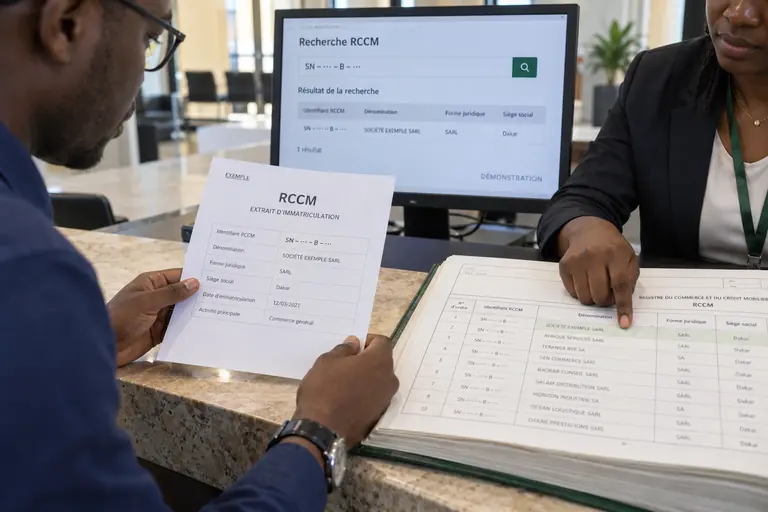
The Cameroon RCCM company register and business records prove that a trader or company really exists, whether it is based in Douala, Yaoundé or Bamenda. RCCM means register of commerce and personal property credit, the file used across the OHADA area. It lists the name, legal form, address, activity and representatives of each business, records later changes, and publishes certain security rights over movable assets. Banks, buyers, tender committees and foreign partners treat an extract from it as basic evidence of identity.
From a national register to a shared OHADA model
Cameroon is a founding member of OHADA, the organisation that gave many African states, across Central and West Africa, a common business code. Registration of traders and companies therefore follows uniform rules on content, effects and publicity. The RCCM replaced older national arrangements, and companies today are measured against the same notions as their counterparts in Gabon, Chad or Senegal.
What makes the Cameroonian setting distinctive is its legal and linguistic mix. English and French are both official languages, and the country inherited elements of both common law and civil law. OHADA texts apply across the territory, yet the practice of an office in an English-speaking region may feel different from that of a busy registry in Douala.
The register carries three functions. It gives the status of trader to those who exercise commerce as a profession, it grants legal personality to commercial companies from the date they are registered, and it makes security interests on movable goods visible to third parties. Each function justifies the demand for accurate and updated entries.
Readers who work with Cameroon often compare it with its neighbours in the CEMAC area. The comparison is useful for vocabulary, since terms such as manager, registered office and share capital have the same legal meaning, but it should not be pushed too far. Procedures, counters and supporting documents are decided locally, and a method that worked in Gabon or Chad may need adjustment here.
Registry offices and the territorial logic of filings
Filings are received by the registry of the competent court, which in the main towns is a court of first instance. The right office is generally the one whose area covers the business address. A company established in the economic capital deals with the registry there, while a firm in the political capital turns to the Yaoundé registry.
The registry clerk checks the application, enters the details and issues the registration number. Later amendments, such as a new manager or a transfer of the registered office, are filed at the same place. If a company moves to another jurisdiction, its file has to follow, which is why searches sometimes need to look in more than one place.
OHADA law also envisages a national file and a regional file kept at the common court of justice and arbitration. These central files are designed to avoid double registrations and to facilitate searches that go beyond one court. Whether a given enquiry can use them directly depends on current administrative practice, so the clerk remains the first contact.
Reading the information contained in a Cameroonian entry
An entry typically identifies the registered name, any trade name, the legal form and the main establishment. The description of the activity helps to judge whether the company is a small trading house, a service provider or an industrial operator. For a company, the share capital and the identity of the manager or directors are recorded as well.
Powers of representation are among the most useful details. A signature on a contract is valuable only if the signatory is authorised, and the register shows who may bind the company and whether certain acts require a joint signature. Comparing the person who signs with the name on the entry is a quick, low-cost verification.
Cameroon also uses a unique taxpayer identifier issued by the tax administration. It is distinct from the registration number in the commercial register, and professionals often request both on invoices and contracts. If the two documents show slightly different names or addresses, ask for an explanation or a recent extract before proceeding with any payment.
Company formation through the business formalities centre
New businesses are encouraged to use the centre for business creation formalities, a one-stop service that gathers the procedures linked to launching an enterprise. It coordinates the registry, the tax office and social security so that the founder files one dossier. The centre does not replace the registry; it channels the application to it and returns the documents.
Founders prepare articles of association, identity papers for all partners, proof of a business address and evidence of capital contributions where relevant. The details vary with the form chosen, whether a sole proprietorship, a private limited company or a public company. Current requirements and counters should be checked directly, because administrative reforms are frequent.
Foreign investors often ask whether a local partner or a local address is compulsory. The answer depends on the legal form, the activity and any sector rules, and cannot be safely generalised. A local lawyer or a chamber of commerce can explain the options, including how a branch of a foreign company is registered in comparison with a new subsidiary.
After registration, a business still has tasks to carry out. It must keep its entry up to date, report any change in its management or address, and meet its tax and social obligations. Many problems arise years later because a manager left or an office moved and nobody informed the registry, so the extract no longer matched reality.
Looking up a company and obtaining proof of registration
A search begins with the most precise element available: the registration number, the exact corporate name or the town of establishment. Companies often share words such as Cameroon, Trading or Services, so an approximate name can produce several candidates. Collecting the address and the manager’s name beforehand makes it easier to confirm that the right entity has been found.
The official outcome of a search is an extract, which reproduces the entries as they stand on the day of issue. Banks, public buyers and customs offices usually insist on a recent one. Because online services, prices and delays change, readers should ask the registry directly whether a digital request is possible or whether a visit is required.
Documents used abroad may need translation or legalisation, depending on the destination. Cameroon’s two official languages help, yet a French document presented in an English-speaking country may still need a sworn translation. Keeping the extract’s date, the issuing office and a copy of the request makes later verification easier.
A person who is not in Cameroon can still carry out a verification. A local lawyer, a bank correspondent or a chamber of commerce can request the extract and send a scanned copy, and the original can follow by courier if the recipient demands paper. Mention precisely which business is meant, since similar names are common among trading firms.
What the register cannot tell you
A registered business is not necessarily an active one. Some companies stop trading without a formal removal from the file, and others are registered but never begin operations. The register also says little about debts, disputes or the quality of products and services, so it cannot replace commercial references.
Sector licences are separate. Forestry, mining, oil services, telecoms, finance and transport each require their own authorisations, issued by ministries or regulators. A company may hold a valid registration yet lack the permit needed for the work it advertises. Always ask for both documents when the activity is regulated.
The remarks above are general information and do not amount to legal advice for a particular case. Procedures, offices and online tools can change, and local practice sometimes differs from the written rules. For an important contract, confirm the position with the registry, a notary or an experienced Cameroonian lawyer before relying on any entry.
Frequently asked questions
Where is the Cameroon RCCM kept?
It is kept by the registry of the competent court, generally a court of first instance, according to the business address. Main offices are found in cities such as Douala and Yaoundé. Amendments are filed at the same office, and OHADA law also provides for national and regional files.
Can an English-speaking region use the same register?
Yes. OHADA rules apply throughout the territory, and the register is the same system whichever region the business is in. Practice and language of service may vary, so applicants should check which language the local registry uses and whether translations are expected for foreign use.
What is the difference between the RCCM number and the taxpayer number?
The RCCM number identifies the entry in the commercial register, kept by the court registry. The unique taxpayer identifier is issued by the tax administration for fiscal purposes. Partners commonly ask for both, since each answers a different question about the business.