
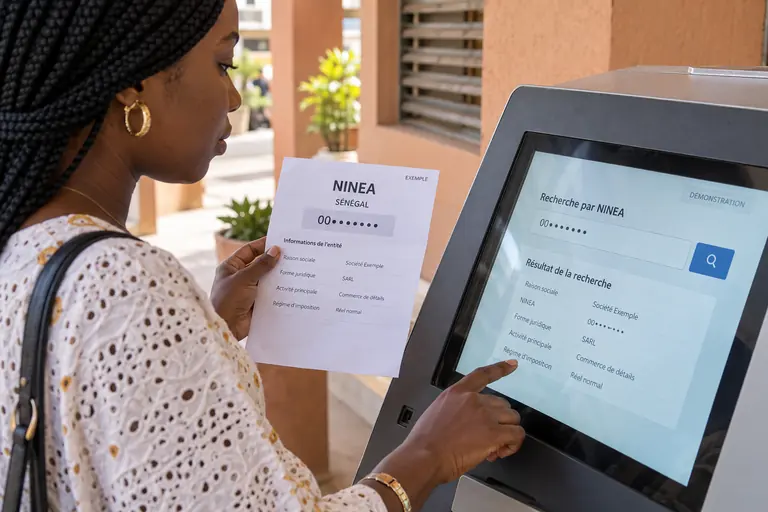
In Senegal, a company search by NINEA identifier relies on the national identification number for enterprises and associations, the code that singles out one entity among many. Managed by the national statistics and demography agency, the number is given to companies, sole traders, associations and other economic units that are recorded in the statistical directory. It is wider in scope than the commercial register number, since it also covers non-trading bodies, and it shows up on invoices, tenders, bank files and tax forms as a common reference.
What the NINEA designates
NINEA stands for the national identification number of enterprises and associations. As the name suggests, it does not concern only commercial companies: associations, groups, individual businesses and various other economic structures may hold one. The number therefore gives a single type of identifier to entities of very different natures, which is its main strength. This breadth separates it from the commercial register number, which targets only traders and companies subject to registration. An economic actor can hold a NINEA without a register number, for example an association, whereas a trading company will normally carry both. Knowing which of the two you are reading on a document avoids misunderstandings.
In practice, people meet the number on letterheads, price quotes and contracts long before they ever search for it. That daily visibility is what makes it so useful as a starting point for checking who is behind a business in the country. Researchers and journalists also rely on the number to follow an entity through the public record. Because it is unique, it avoids the confusion that arises when dozens of associations or firms share the same words in their names, such as a region, a saint or a common trade.
Who allocates the number and why
The NINEA is kept by the national agency for statistics and demography, which runs the directory of enterprises and associations. The original aim is statistical: to count economic units in the country and produce dependable data on the productive fabric. The agency refers in its publications to entities newly entered in that directory. Over time the number has become an everyday administrative tool. It appears in tax forms, public procurement files, bank account openings and social declarations. This double nature, statistical and practical, explains why it is found on most invoices and official papers issued by Senegalese entities.
The result is a shared point of reference for all economic actors. Banks, revenue officers, customs and social bodies can attach filings and payments to the right entity without relying on names, which are often similar from one business to another. Funders and development partners value the directory for a similar reason. A recognised number lets them distinguish an established association from an informal group, and it gives auditors a fixed key for tracing grants, contracts and payments to one legal or economic unit over several years.
NINEA and the commercial register: two complementary numbers
Senegal belongs to OHADA, and its traders are entered in the Trade and Personal Property Credit Register kept at the competent commercial court registry, notably in Dakar. The register number proves the legal existence of a trading business and records its management details. The NINEA acts as a cross-cutting identifier in administrative databases. The tax administration mirrors this complementarity. Its portal for businesses includes an entry devoted to the NINEA and register pair, which shows that officials expect to see both. For a serious check, note both numbers and confirm that they point to the same name and the same head office.
When a bank opens a file, it will typically ask for the two together. A business that can supply only one of them is not necessarily irregular, but the gap calls for an explanation, particularly if the activity is commercial and the register number should exist. A further difference is purpose. The register number results from a legal obligation tied to trading, with consequences for liability and credit, while the statistical number exists to classify and count. Both are asked of a serious supplier, and a tender file that lists only one of them may be treated as incomplete.
Where the number can be found
The number normally figures on a business's invoices, quotes, purchase orders, letterheads and contracts. It is also reproduced on the statistical registration certificate issued by the agency, a document that administrations often ask for. Public tenders and banking files require it to be filled in, so spotting it on such papers is the first move in any verification. If a partner does not volunteer the number, ask for it in writing. An entity unable to produce it may be in the middle of regularising its status, or may not be registered at all. Neither explanation is reassuring when the relationship involves substantial amounts.
Take the number from an original document rather than from an advertisement or an online profile with no stated source. Social media pages and marketplace listings are easy to fake, and a copied number from such a place proves nothing about the real owner. Large buyers often keep a supplier file in which the number is stored with the name, address and contact. When the number on a new invoice differs from the one in the file, the accounts team should pause the payment and ask the supplier to explain, since a changed identifier can reflect a restructuring or an attempt at fraud.
A practical method for checking
Start with the internal consistency of the number: its length, its shape and the absence of doubtful characters. Then compare it with the declared name, address and activity. If one item does not fit the others, an explanation is needed. A badly copied number is a frequent cause of failed searches. Final confirmation comes from the body that manages the directory or from the tax administration, which can be asked for a certificate. Online query options and their access conditions change, so they are best checked on official portals. No external check is as reliable as a dated, signed document issued to the business itself.
Keep a note of the date, the person you spoke to and the answer you received. If the entity later changes address or form, that note shows what you saw at the time and lets you decide whether a new check is worth the effort. If a record cannot be confirmed immediately, do not treat silence as a negative answer. Services can be slow, offices can be closed and databases can lag behind real events. Write down what you tried, repeat the request through another channel and keep the business informed that its file is incomplete until the check is done.
Common mistakes and the limits of the identifier
The most common mistake is confusing numbers. A partner may hand over a tax identifier, a register number or a social security number while claiming to give the NINEA. Each reference has its own structure, and matching it to the business name reveals the mix-up quickly. Homonyms are the second trap. Several entities may bear similar names in Dakar, Thiès, Saint-Louis or Ziguinchor, with activities that have nothing in common. The number settles the question, provided it was taken from an authentic document.
The NINEA identifies an entity but guarantees neither solvency nor honourability nor tax compliance. Cross it with the register extract, the articles, the latest declarations and, where one exists, an auditor's report. When a company changes legal form it may keep or receive a new identifier, so read any mention of takeover carefully. Banks and compliance teams add another layer, because they also need to know who ultimately owns and controls a business. The identifier does not provide that. Use it as the anchor for the entity, then collect articles, shareholder lists and identity papers of managers through separate requests and proportionate checks.
Frequently asked questions
Is the NINEA the same as the commercial register number?
No. The NINEA comes from the statistical directory and covers associations and individual businesses as well as companies. The register number comes from the commercial court registry and applies to traders and companies. A trading company normally holds both, and they should match the same name and address.
Who can ask for a NINEA certificate?
The entity itself requests the statistical registration certificate from the agency that keeps the directory. Partners, banks and public buyers usually ask the business to produce it. Conditions can change, so confirm the current procedure with the agency or the tax administration.
Does having a NINEA prove a business is legitimate?
It proves that the entity was recorded and received an identifier. It does not prove that it trades regularly, pays its taxes or is solvent. Combine it with the register extract, financial statements and references before committing money.