Official company extracts and certificates issued by registries
Official company extracts are documents issued by a registry to prove the legal situation of a business on a given date. Banks, courts, tenders and foreign authorities often require them, and each type of extract proves something different.
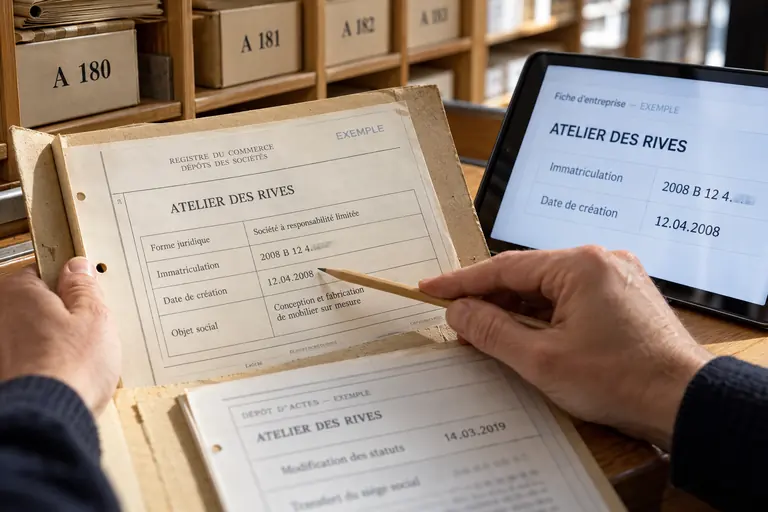
What official company extracts are and what they prove
Official company extracts reproduce, in a structured form, the data held by the registry about one entity. It usually carries the identity of the company, its legal form, its seat, its representatives and its status. Because it comes from the keeper of the record, it has an evidential value that a screenshot or a web page does not have.
The document is dated, and that date is essential. An extract describes the situation on the day it was drawn up, and nothing guarantees that the facts remain unchanged afterwards. For this reason, institutions that request official company extracts often add a condition on how recent the document must be.
Wording changes from country to country, which complicates the search for official company extracts abroad. The same idea is called an extract, a certificate, a copy or an excerpt, and some systems use a local name such as Kbis in France, Handelsregisterauszug in Germany or nota simple mercantil in Spain. These names are examples of local practice and do not always correspond exactly to each other.
Common types of commercial register extract
Among official company extracts, the most frequent type shows the current entry, with no history. A longer version includes past entries, such as former names, former managers or former addresses, and offers a fuller picture for a due diligence file. Some registries offer both, and applicants choose according to the purpose.
Other certificates answer a narrower question. A certificate of incorporation shows that the company was formed, a certificate of good standing states that it is in compliance with its filing duties, and a certificate of incumbency or of representation lists the persons authorised to act. A negative certificate may confirm that no entry exists, for example about insolvency.
In several jurisdictions, a certified copy of a specific deed is available too. Articles of association, a resolution or a filed form can be requested as a copy bearing the stamp or the electronic seal of the registry. These copies are valuable when a counterparty challenges the content of a document.
Who issues a registry certificate and in what form
Only the body responsible for the register can issue genuine official company extracts. Depending on the country, this may be a court clerk, a chamber of commerce, a registrar of companies or a state office. In the United States, for example, the corporations division of a state, such as the Delaware Division of Corporations, provides certificates of good standing for entities formed there.
Form is changing. Paper originals with a stamp and a signature are still used, yet many registries now deliver electronic documents with a qualified signature, a seal or a verification code. A recipient can often check the authenticity of such a file online, which is a strong guard against forgery.
Applicants should avoid intermediaries that merely resell a document available directly from the registry. Some websites imitate official portals and add fees without adding value. Starting from the official site of the registrar is the safest approach.
How to order official company extracts step by step
To order official company extracts, the first step is to identify the entity precisely, ideally with its registration number. The second is to pick the type of document and, where offered, the language and the level of detail. The third is to pay any fee and to receive the document by download, by email or by post.
Identification of the applicant varies. Some registries deliver extracts to anyone, since the register is public, while others ask the user to create an account or to state a purpose. Documents containing personal data may be limited to persons who prove a legitimate interest.
Processing time and cost are set locally. They can depend on the channel, the format and the urgency, and they change from time to time. The current conditions are shown on the official portal, and they should be checked before an order is placed for an important deadline.
Validity, translation and use abroad
Official company extracts intended for another country raise extra formalities. Authorities in the receiving state may demand a recent date, a translation by a sworn translator and a legalisation. Where the Hague Apostille Convention applies between the two countries, an apostille issued by the competent authority of the issuing state is generally the required step.
Within the European Union, rules on multilingual standard forms and on the exchange of corporate information reduce some of these steps for certain documents. Even so, a receiving body can have its own requirements, and it is wise to ask it which version it will accept.
Validity periods are rarely written in the law for extracts as such. Instead, the body that asks for the document sets a limit, often a few weeks or months. Ordering the extract close to the date when it is needed avoids a refusal on the ground that it is too old.
Typical uses of a registry certificate
Banks request such documents when they open an account, grant a loan or perform know-your-customer checks. Public buyers ask for them in tender files, and notaries require them for transactions such as the sale of shares or property. Courts and bailiffs rely on them to identify the right defendant.
Business partners use official company extracts to build trust. A supplier may ask for a certificate before granting credit terms, and an investor will verify that the person signing a contract is truly entitled to do so. A recent extract settles these questions with a single document, which explains why so many firms keep a standard request ready. Some also keep a file of earlier extracts to show how the company has evolved.
Individuals also need such papers, for example a manager who must prove a function or a shareholder who wants to demonstrate the standing of a firm. In all these cases, the document must match the purpose, since a basic extract cannot prove what only a certificate of good standing can show.
Limits and precautions with official company extracts
Official company extracts prove what is recorded, not the economic health of the business. It will not reveal the quality of products, the level of debts or pending disputes unless these are matters the registry has to record. Treating it as a certificate of reliability is a common mistake. Credit ratings, court judgments and financial statements come from other sources and need separate requests.
Errors and delays happen with official company extracts too. A recent decision may not yet be entered, and a mistake in the record can persist until it is corrected on request. When an extract looks inconsistent with other documents, the discrepancy should be raised with the registry.
Finally, the fee, the delay and the content of official company extracts are matters of local law and practice, and no general statement can replace a check with the registry itself. For complex cross-border situations, a lawyer or notary familiar with both countries gives advice adapted to the case.