Company directors and shareholders: reading management and ownership data
Company directors and shareholders are the two groups of people behind any legal entity, one running it and the other owning it. Public registers disclose them to very different degrees, and understanding the distinction helps to read a record correctly.
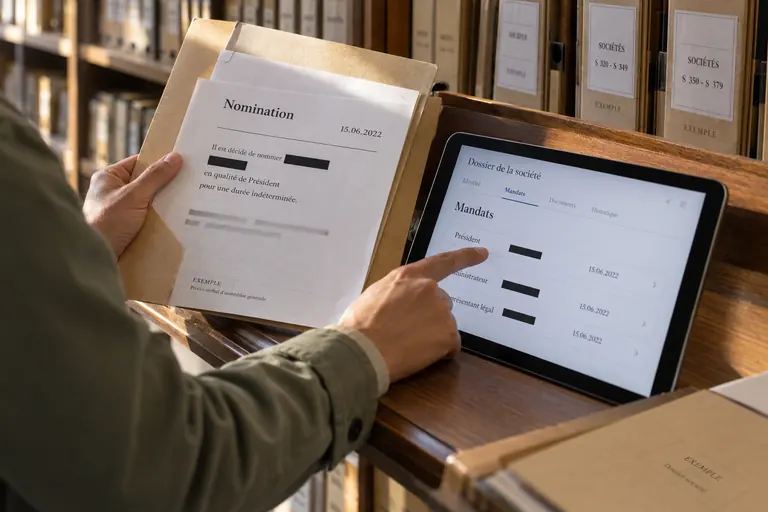
Directors, managers and legal representatives in the register
Company directors and shareholders play distinct roles. Directors and managers take decisions, sign contracts and answer for the conduct of the business, whereas shareholders or members provide capital and hold rights of ownership. In small companies one person can be both, but the legal functions remain separate. In larger groups the two circles hardly overlap, and a board may answer to owners who never appear in daily management.
Titles vary with the legal system. Director, manager, managing director, president, board member, administrator, gérant and Geschäftsführer all describe people who may act for a company, with differing powers and liabilities. A register entry normally states who can bind the company and whether they act alone or jointly.
For this reason it is not enough to read a name on a record. The role, the start date and the extent of the signing authority tell whether the person met at a negotiation can truly commit the business. Where powers are limited, the register or the articles of association will usually say so. Joint signature clauses are a frequent example: two managers must sign together, and a single signature then does not bind the company.
What the registers show about company directors and shareholders
Disclosure of directors is the norm in most registries, whereas shareholders are less visible. The record typically gives the name, the function and the date of appointment, and it may list previous appointments and resignations. Some registers show the nationality, the month and year of birth or a correspondence address, while others limit the data.
Shareholders are treated less uniformly. Public companies may have to disclose large holdings under securities rules, and some registers of private limited companies list members with their share percentages. In other systems, ownership is known only to the company and to certain authorities.
Where the register does not display ownership, a request for the articles of association, the share register held by the company or a notarial deed may be the only way to learn who owns what. Such documents are not always public and may demand a legitimate interest.
Share capital and ownership structure
The share capital recorded in a register indicates the amount contributed or promised by the owners, not the value of the business. In several systems it must be stated in the articles and may be shown in the extract. A low or high figure says little about the real worth of the company.
For company directors and shareholders alike, ownership structure matters more for understanding control. A company may be held by individuals, by other companies, by trusts or by funds, and chains of holding companies can stretch across several countries. Following the chain of company directors and shareholders demands consultation of the registries of each jurisdiction involved.
Different classes of shares add complexity. Preference shares, bearer shares where still permitted and nominal holdings are examples that readers meet in practice. Voting rights, dividend rights and transfer restrictions can differ between categories, so a holder of a minority of capital may control a majority of votes. The articles of association and shareholder agreements contain the details, and they are not always publicly available.
Beneficial ownership and persons with significant control
Beneficial ownership registers aim to identify the natural persons who ultimately own or control a legal entity. They were created in response to concerns about money laundering, tax evasion and corruption. In the United Kingdom, Companies House records persons with significant control, while other countries have set up separate registers with their own rules.
Access to data on company directors and shareholders is not identical everywhere. Some countries open their data to the public, others restrict it to authorities, banks and persons showing a legitimate interest, and legal and regulatory developments have changed several regimes in recent years. Anyone relying on such data should check the current rules in the country concerned.
Open Ownership, a non-profit organisation, promotes beneficial ownership transparency and publishes research on how registers can be designed and used. Its materials help to compare approaches and to understand why data quality and verification differ.
Searching for the officers of a company
To find the company directors and shareholders tied to a business, start with its record in the register of its country. Search by name or number, then open the section on officers, managers or representatives. In some portals that section is a separate tab, and in others it forms part of the extract.
Some registries allow a search from the other side, starting from the name of a person and listing the entities where this person appears. This feature is useful for checking whether someone holds several mandates, but homonyms are frequent, and a match is not proof of identity. Dates of birth, when shown, help to separate people with the same name. The history of appointments is also informative, since a person who has joined and left many companies in a short time may call for closer attention. A long list of past mandates is not an accusation, and it should be read together with the status of each entity.
Remember that data on company directors and shareholders may lag behind reality. Appointments take effect on one date and are recorded on another, so a recent change might not yet be visible. A request for an up-to-date extract reduces this risk.
Privacy and the limits of public information
Data protection law affects what registers publish about company directors and shareholders as individuals. Residential addresses may be replaced by a service address, dates of birth may be partly masked, and identity numbers are generally kept private. These measures protect people from harassment and identity theft while keeping the essential facts open.
Some company directors and shareholders can request the removal or suppression of certain details in special circumstances, such as a risk of violence. The procedures and conditions are set by national law.
Information on company directors and shareholders also has limits of substance. A register does not reveal informal control, side agreements or the real influence of advisers. Nominee arrangements, where a person holds shares or serves as a director on behalf of someone else, can hide the actual decision-maker, which is the reason beneficial ownership rules exist.
Using management and ownership data wisely
When verifying a counterparty, compare company directors and shareholders named in the register the people named in the register with the people who negotiate and sign. A mismatch deserves an explanation, such as a recent change or a power of attorney. Documents proving the authority of a signatory may be requested.
Due diligence on larger transactions usually adds checks beyond the register. These include sanctions lists, court records, media research and, where relevant, regulatory licences. The register is the foundation, and other sources complete the picture.
This text provides general information and not legal advice. The rules on disclosure, liability and ownership are national, and a lawyer or notary familiar with the jurisdiction should be consulted before relying on the data for a significant decision.