Company insolvency records: bankruptcy, liquidation and legal status
Company insolvency records show whether a business is being wound up, restructured or declared bankrupt, and they complement the legal status displayed in the commercial register. They are held by courts, gazettes and registries, and the place to look differs from one country to another.
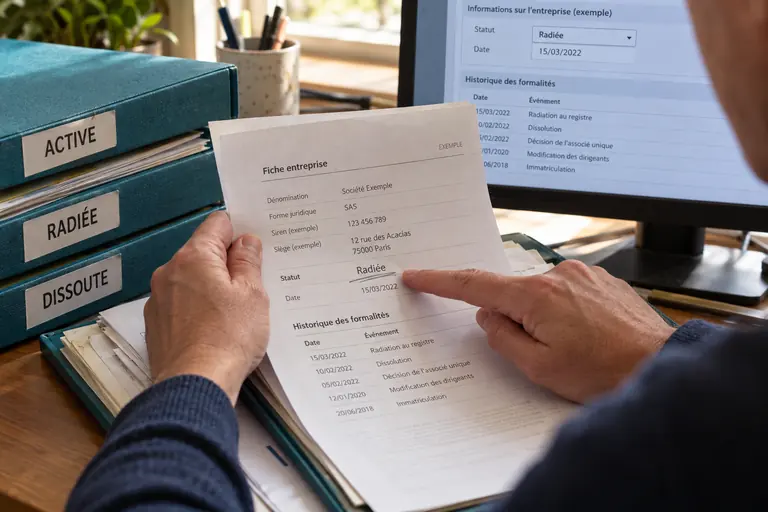
Legal status of a company and why it matters
The legal status of a company tells whether it can lawfully trade. An active entity may enter into contracts, an entity in liquidation may only perform acts needed to close its affairs, and a dissolved entity has in principle ceased to exist. Before dealing with a business, the status is among the first facts to check. A lender, a landlord or a supplier will often ask for it first. Where the status is unclear, further reading of the notices is the logical next step.
Statuses and company insolvency records are not standardised across the world. A single word, such as inactive or dormant, may describe a company that has stopped trading but remains registered, or one that the registry has flagged for missing filings. Reading the explanation provided by the registry avoids a wrong interpretation.
Status can change quickly. A court decision, a shareholder resolution or a registrar action may alter it, and the register will show the new situation only after the information is received and entered. A difference of days or weeks between the event and the record is not unusual.
Types of insolvency proceedings and winding-up
Insolvency law distinguishes several paths, and company insolvency records reflect each of them. Liquidation or winding-up ends the life of the company and distributes its assets to creditors. Reorganisation, administration or protection procedures try to keep the business alive, often under the supervision of a court or an appointed practitioner.
Voluntary and compulsory routes exist side by side. A solvent company may close in an orderly way, which is very different from a forced closure. Members may decide to wind up a solvent company, a creditor may petition a court against an indebted one, and the managers themselves may be obliged to file when the company cannot pay its debts. Names and conditions depend on the national statute.
The consequences recorded in company insolvency records differ with the procedure. In some systems, managers lose their powers and a trustee takes control, while in others the existing management stays in place under supervision. Contracts, employment and security rights are treated according to specific provisions of the applicable law.
Where to find company insolvency records
There is rarely one single place. Courts that open proceedings often hold the file, and a public notice is published in an official journal or in a dedicated insolvency portal. In the United Kingdom, The Gazette is the official public record in which insolvency and company law notices appear, and Companies House also shows insolvency information on a company’s record.
Germany publishes insolvency announcements on a dedicated judicial portal, separate from the commercial register, while the register itself can carry an entry on the opening of proceedings. Norway’s registry centre publishes official announcements and keeps entries on bankruptcies and winding-up for the entities it registers. These examples show that the same fact may be recorded in more than one place.
The commercial register is therefore a starting point for company insolvency records and not always the complete answer. A search in the register may show a status, and the related court notice or gazette entry gives the date, the court and the name of the practitioner. Combining both sources provides a fuller view. When the entity operates in several countries, proceedings opened abroad may be recognised or run in parallel, so foreign records deserve a check too.
Reading bankruptcy and liquidation notices
In company insolvency records, a notice normally states the name and number of the entity, the court or authority, the type of procedure, the date of the decision and the name of the person appointed. It may also give a deadline for creditors to submit claims. That deadline is important, because a missed date can reduce the chance of recovery.
Language is technical and varies. Terms such as receivership, administration, liquidation, bankruptcy, reorganisation, composition and judicial settlement are used in different systems, and a literal translation can mislead. A professional translation or a local adviser helps with complex files.
Notices are snapshots. Each one is dated, and it speaks only for that date. They reflect the stage of the procedure on the publication date, and later decisions may follow in separate notices. Following the sequence of announcements gives the full story from opening to closure.
Dissolved, struck-off and restored companies
Many registries keep company insolvency records and other traces of entities that no longer exist. A company can be dissolved after liquidation, struck off by the registrar for failure to file or to pay charges, or merged into another entity. Each route has different implications for creditors and owners.
Removal does not always put an end to claims. In some countries, assets discovered after removal can still be dealt with, and the entity may be restored to the register by a court or an administrative decision for a limited period. This explains why old debts can reappear.
Access to company insolvency records and to dissolved entities is variable. Certain registers keep them visible for a long time, others hide them from public search after a set period, and archives may be available on request. A negative result in a search should therefore be treated with caution.
What the register does not tell you about financial distress
Company insolvency records show formal events, and they do not reveal early warning signs. A company can be in serious difficulty long before a petition is filed. Late payments, delayed accounts, frequent changes of management and unpaid taxes may be hints, yet none of these appears in a simple status field.
Equally, an entry in the register does not prove that a firm is sound. A clean record may simply mean that nobody has yet acted against the company. Public data confirms legal facts, and the economic situation requires other sources, such as filed accounts, payment records and credit information from specialised providers. These sources have their own limits and costs.
Personal insolvency of owners or managers is usually handled in separate records, which may be restricted. A search focused on the entity will not necessarily reveal them.
Practical checks before dealing with a troubled business
Check the register and the company insolvency records on the same day as signing or paying. Keep dated proof of what was displayed, and ask the counterparty to confirm in writing that no proceedings have been opened or requested. For larger amounts, a lawyer can advise on security, guarantees and the risks linked to transactions made shortly before an insolvency.
Some systems allow courts to challenge payments or transfers made in the period before proceedings began. The rules are national and technical, and no general statement can replace local advice.
This text describes company insolvency records in general terms. It does not give legal advice, and procedures, deadlines and publication channels should always be confirmed with the court, the registry or a qualified professional in the country concerned.