Company registration procedures: from incorporation to deregistration
Company registration procedures describe the steps by which a business obtains legal existence, keeps its record up to date and eventually leaves the register. The sequence is broadly similar across countries, but formalities, authorities and timing differ widely.
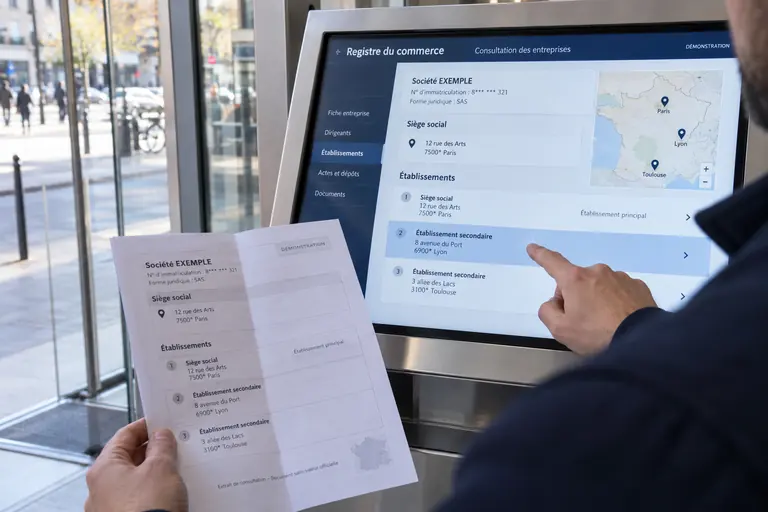
The main stages of company registration procedures
In company registration procedures, a company usually goes through the same major phases. It is created by a founding act, it is entered in the register, it reports later changes and it is removed when its life ends. Each phase has its own forms, its own filing office and its own legal consequences.
Company registration procedures are more than an administrative step. In many systems the entity acquires legal personality only when it is entered, which means that acts done before that moment may engage the founders personally. Understanding this early point avoids unpleasant surprises.
Several authorities may take part in company registration procedures. Besides the registry itself, tax offices, social security institutions, statistical bodies and licensing departments often receive the same data or issue their own numbers. Some countries have merged these steps in a one-stop shop, whereas others still ask for separate applications.
Preparing an incorporation filing
The file for company registration procedures normally starts with the choice of the legal form. A limited liability company, a joint-stock company, a partnership and a sole proprietorship each carry different rules on capital, liability, governance and publicity. The choice conditions the content of the incorporation filing and the body to which it is addressed.
Typical documents include the articles of association or a similar founding deed, proof of the registered address, identification of the founders and managers, and a statement on share capital where the law requires one. In some countries a notary must authenticate the deed, while in others private signed documents are enough.
A name check comes early. Trade marks held by others and protected designations can also stand in the way, even if the registry itself raises no objection. Many registries refuse a name that is identical or confusingly close to an existing one, and some reserve names for a limited period. The result of this control is specific to each country and depends on the registry’s practice.
Registering a company with the competent registry
Once the file is complete, it enters the company registration procedures proper and is submitted to the register. The channel may be an online portal, where signatures are given electronically, a counter at the court or chamber, or an intermediary such as a notary who files electronically on behalf of the founders. Examples of national portals include the Brønnøysund Register Centre in Norway, where registration and changes are handled for many entity types.
The registrar reviews the file. Review can take the form of a quick formal control or of a thorough examination of each clause. Some registries perform a legal check of the content, while others record what is declared and place responsibility on the signatories. If a document is missing or incorrect, the application is usually returned with a request for correction.
After acceptance, the company receives its registration number and, in most systems, a proof of registration. That proof is the document that banks will request to open an account. Some registries also publish a notice of the new entry, which makes the creation of the company public. Fees and delays depend on the country and the legal form, and the current conditions are to be read on the registry’s own site.
Amendments and updating the register
Company registration procedures continue after incorporation, since a company must report changes that the law considers important. Typical examples are a new name, a transfer of the seat, a change of corporate object, an increase or reduction of capital and the appointment or departure of a manager. Each of these amendments and updates normally requires a form, supporting minutes and, sometimes, a notarial deed.
Time limits for reporting changes exist in many jurisdictions, and failure to comply can lead to penalties or to the loss of certain protections. The applicable period is set by national law and should be verified. Some registries send reminders, others do not.
In federations the same logic is applied at the level where the company was formed. In Canada, for instance, Corporations Canada deals with federal corporations, including annual returns and changes of directors or registered office, while provincial bodies handle provincial companies. A change must therefore be filed with the right authority.
Annual duties and ongoing filing requirements
Many registers build periodic filings into their company registration procedures, whether an annual return, a confirmation statement, an annual report or a deposit of accounts. The purpose is to keep the public record current and to show that the entity is still in business. Missing such deadlines can lead to fines and, in the long run, to compulsory removal.
Some registers also charge an annual fee or require payment of a franchise or similar tax to remain in good standing. This is common in certain US states, for example. Where it applies, unpaid charges can lead to a status downgrade visible to the public.
Companies should keep a calendar of these obligations and designate someone in charge. A missed date is often noticed only when a bank, a client or an official asks for a current extract, and by then a penalty may already have accrued. Professional service providers, accountants and registered agents often manage deadlines for clients. The responsibility, however, stays with the company and its managers.
Deregistration, dissolution and removal from the register
Company registration procedures also cover the end of a business, and a company that ends its activity does not vanish automatically. It must normally be dissolved by a decision of its members or by a court, then liquidated, and finally deregistered. The register records each of these steps, and the entity often remains visible with a status that explains its situation.
Voluntary closure requires that debts are settled or provided for, that employees and tax authorities are informed and that a liquidator is appointed where the law demands one. The details vary strongly between countries, and the order of the steps may differ. A premature removal can create liabilities that survive the entry’s disappearance.
Some registries strike off dormant companies on their own initiative after repeated failures to file. Restoration is possible in several systems for a limited period, subject to conditions and a court or registrar decision.
Practical advice and frequent mistakes in registration
Frequent errors in company registration procedures include choosing a legal form without understanding liability, using an address that cannot receive official mail, and failing to register changes of managers. Another is treating the register as optional when a contract signed before registration leaves the founders personally exposed.
It is useful to compare the official guidance of the registry with advice from a lawyer, accountant or notary. Procedures are updated by legislation, and portals sometimes modify their forms. Using outdated forms found on third-party websites can delay an application.
This text gives general information on company registration procedures and does not constitute legal advice. For a precise project, the competent registry, a professional adviser or the chamber of commerce of the country concerned should be consulted before filing.