Company registry search: how to find a business and read its record
A company registry search turns a name, a number or an address into an official record showing whether a business exists and in what condition. Good results depend on choosing the right register, the right identifier and a careful reading of the status displayed.
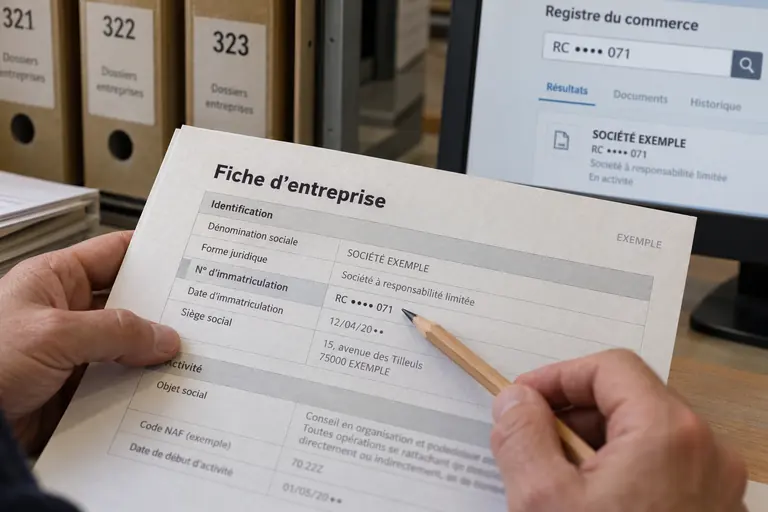
Before you start a company registry search
Preparation saves most of the effort in any company registry search. Gather everything known about the business: its full name, the country and town of its seat, its legal form and any number printed on an invoice, a contract or a website footer. The more details are available, the easier it is to pick the correct record among similar ones.
The next question is which register holds the information. A company registry search in the wrong country, or in the wrong territory of a federal state, returns nothing even if the business is perfectly real. The place of incorporation, not the place where goods are sold, normally decides.
It is also worth deciding what you want to learn. Confirming existence, checking who may sign a contract, tracing an address and reading filed accounts are different goals, and they may lead to different registers or to different tabs of the same portal.
Searching a business register by name, number or address
In a company registry search, the registration number is the most dependable key. It is unique within a register, it does not change when a trade name changes, and it avoids confusion between homonyms. When a number is known, entering it in the search field usually leads straight to one entry.
Name-based company registry search needs more care. Legal forms appear in many shapes, such as Ltd, GmbH, SARL, S.A., S.L. or Inc., and a portal may require or ignore them. Trying the name with and without the legal form, with and without accents and with alternative spellings often reveals records that a first attempt missed.
Some registers also allow searches by address, by activity code or by the name of a manager. These options help when the name is uncertain, though results can be long and need to be filtered. Wildcards and partial names are accepted by certain portals and rejected by others, so the help page of the portal is worth reading. Results are often sorted by relevance or alphabetically, and only the first page may be shown by default, so scrolling through every page avoids overlooking the right entity.
Reading the company lookup result
The result of a company registry search generally starts with identification data: name, number, legal form and registered address. Next come the status and, in many registers, the date of incorporation or of the last change. These elements are the quickest indicators of whether the business is alive.
Status labels must be read in their local context. Active, in liquidation, dissolved, struck off, dormant and under administration have different consequences, and the same label can mean slightly different things from one country to another. The glossary or the legal notice of the register explains the terms used.
Documents attached to the record deserve a look as well, because they show how the company has evolved. Filed deeds, notices and annual returns tell a story that the summary cannot, for instance a recent change of managers or a transfer of the seat. A record with no recent filings may signal an inactive business or simply a jurisdiction where little is required.
When a company search returns nothing
An empty company registry search result does not prove that the business does not exist. The name may be spelled differently, the entity may be registered under another name from the one used in trade, or it may sit in another register. Sole traders, associations and foreign branches are the usual surprises.
Another cause is timing. A newly formed company may not be visible for some time, and a company removed long ago may be hidden from the public index even though archives exist. Portals differ in how long they keep records of entities that disappeared.
If the doubt persists, widen the search step by step. Try a shorter fragment of the name, check neighbouring territories and consult the register of establishments or the tax register where one exists. A phone call or an email to the registry office is often the quickest way to settle the point, especially for a small or very recent entity.
Free and paid access in a business register search
Many registries offer a free first level of company registry search. It typically allows a user to confirm that an entity exists and to see its basic details without paying. Deeper services such as certified extracts, copies of deeds or monitoring alerts may carry a fee, and prior registration of the user may be required.
Conditions change over time, so the current rules should be read on the official portal and not assumed. Charges and delivery times are set by each registry and are not comparable from one country to another.
Commercial resellers also sell company reports built from register data. Some are reliable and add value by combining sources, whereas others simply repackage free public information at a high price. Comparing the offer with what the official portal gives is a sensible reflex.
Using aggregators and international databases
When the country is unknown or several jurisdictions are involved, a company registry search through an aggregator can use a common search box. OpenCorporates, for example, compiles data from official registers of many jurisdictions into one database. Results should be treated as a pointer to the original source and not as a final proof.
Aggregated data may be older than the live register, may omit documents and may present statuses in a harmonised way that hides local nuances. For a decision with legal consequences, the official portal remains the reference. In Germany, for instance, the Unternehmensregister gives central access to data from the commercial registers and to published notices.
Language is another factor in company registry search. Names written in Arabic, Cyrillic, Chinese or Greek script may be stored in the original alphabet and in a Latin form, and the two can differ. Searching in the original script of the name, where it differs from the transliteration, often gives better hits. Official portals sometimes provide an English interface, though the records themselves may stay in the national language.
Checking and documenting the findings of your company registry search
Once a record is found, confirm it with a second element. Compare the address, the legal form and the managers with those shown on the contract or the invoice, and check that the number matches. A mismatch should be clarified before any payment or signature.
Keep evidence of what was found. Note the date, the portal used and the exact search terms entered. A dated screenshot or a downloaded extract shows what the register displayed at the time of the check, which can matter if a dispute arises later. Registers update continuously, and the same search can give a different answer next month.
Finally, remember the limits. A register records legal facts and filings, not commercial reliability. Information from a company registry search is a solid starting point for due diligence, and it does not replace a check of solvency, licences, ownership and reputation carried out with the help of qualified advisers.